
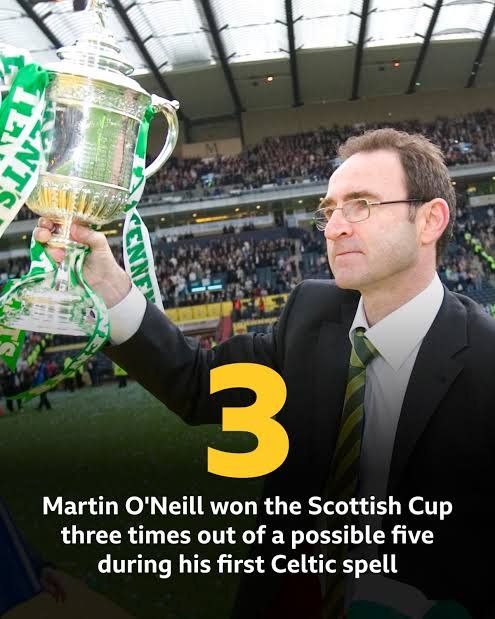
“Pandemonium in Paradise: Martin O’Neill’s Glorious Meltdown Over Celtic’s Cup Charge”
There are celebrations, there are emotional reactions, and then there is Martin O’Neill on a night like this.
Celtic’s hard-fought victory to secure a place in the 2026 Scottish Cup Final should, by any reasonable standard, have been met with measured praise, a nod to the squad’s resilience, and perhaps a nostalgic smile from one of the club’s most iconic former managers. Instead, O’Neill delivered something closer to a theatrical event—part sermon, part battle cry, and part uncontainable eruption of footballing passion.
Within seconds of the final whistle, O’Neill was on his feet, arms flailing as though conducting an invisible orchestra. His voice, already carrying the unmistakable tone of conviction, climbed rapidly into the realm of pure disbelief. “This,” he declared, pointing emphatically at the pitch as if the grass itself had just performed miracles, “is not just a win—this is destiny unfolding before our very eyes!”
It might have seemed like a slight overstatement. After all, Celtic had “only” reached a domestic cup final—a significant achievement, certainly, but hardly the culmination of a once-in-a-generation saga. Yet O’Neill spoke as though the result had rewritten the laws of footballing gravity.
He dissected every moment with the intensity of a man reliving a Champions League final. A misplaced pass in the 23rd minute became “a test of character.” A routine clearance? “A symbol of defiance.” By the time he reached the winning goal, O’Neill’s narration had elevated it into folklore. “That strike,” he insisted, eyes wide with wonder, “will echo through time. Generations will speak of it!”
His co-pundits attempted, occasionally, to steer the conversation back toward reality. They referenced tactics, substitutions, and the opposition’s shortcomings. O’Neill, however, was operating on an entirely different plane. For him, this was not about formations or match-ups; it was about spirit, identity, and the mystical bond between club and supporter.
At one point, he leaned forward, lowering his voice as if sharing a profound secret. “You don’t understand,” he said, shaking his head slowly. “Nights like this—they define eras. This could be the spark… the very spark that ignites something unstoppable.”
It was the kind of statement that might usually be reserved for the brink of a historic treble or a European triumph. Here, it felt magnificently disproportionate—and yet, strangely fitting.
Because that is O’Neill’s gift. Where others see a game, he sees a narrative. Where others analyze, he believes. And in that belief, he creates something infectious. By the end of his impassioned monologue, even the most skeptical viewer might have found themselves wondering: what if he’s right? What if this is the beginning of something extraordinary?
As the broadcast drew to a close, O’Neill finally allowed himself a moment of composure. He sat back, exhaled deeply, and offered a satisfied smile. “Magnificent,” he said simply.
An overreaction? Almost certainly. But in a sport built on emotion, drama, and the occasional leap into the irrational, Martin O’Neill’s outpouring felt less like excess—and more like a reminder of why nights like these matter in the first place.
