
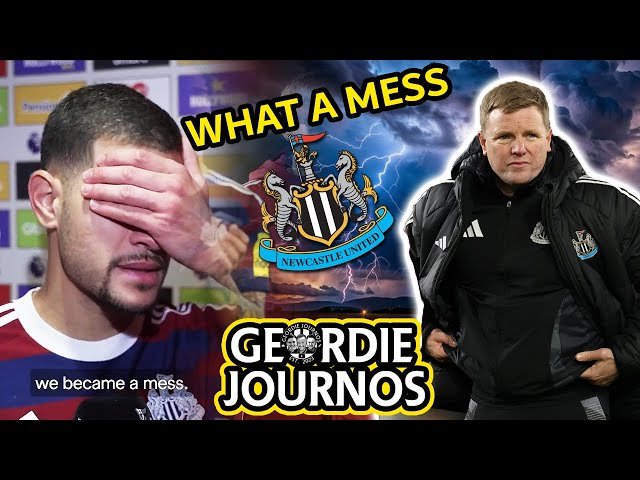
Title: Chaos at Newcastle: Eddie Howe’s Missteps Deepen Uncertainty
Eddie Howe’s recent decisions at Newcastle United have left fans frustrated, confused, and increasingly concerned about the direction of the club. At a time when stability and clarity were desperately needed, Howe instead delivered what many see as a baffling performance—both tactically and in leadership. The result? A team that looked disjointed, a fanbase losing patience, and a growing sense that Newcastle are drifting at a critical moment.
The backdrop to this turmoil cannot be ignored. The uncertainty following the sudden downfall of the club’s CEO has already shaken the foundations behind the scenes. In moments like this, leadership on the pitch becomes even more important. Supporters look to the manager to provide structure, confidence, and a sense of continuity. Instead, Howe’s approach in this match only amplified the chaos.
From the outset, the tactical setup raised eyebrows. Key players were deployed out of position, partnerships that had previously worked well were inexplicably broken up, and the overall game plan lacked coherence. Newcastle appeared unsure of their identity—neither defensively solid nor offensively threatening. It was as if the team had been stripped of its usual intensity and organization.
Perhaps most concerning was the lack of in-game adaptability. As the match unfolded and it became clear that the strategy wasn’t working, there was little meaningful adjustment. Substitutions came too late or failed to address the core issues. The opposition, meanwhile, grew in confidence, exploiting gaps and capitalizing on Newcastle’s disarray. It was a stark contrast in managerial sharpness.
Fans have long appreciated Howe for his steady hand and ability to build a cohesive unit, but this performance felt like a departure from those strengths. Instead of simplifying things during a turbulent period, he seemed to complicate them. The team looked mentally and tactically overwhelmed, which raises serious questions about preparation and communication.
The timing makes it all the more troubling. With off-field instability already casting a shadow over the club, this was a moment to reinforce unity and resilience. Instead, the performance added fuel to the uncertainty. Football clubs often mirror the tone set by their leadership, and right now, Newcastle look unsettled at every level.
Criticism of Howe is not without context—he has previously done an admirable job in elevating the club and instilling belief. However, football is a results-driven industry, and moments like this demand accountability. Supporters are not just reacting to a single loss or poor display; they are reacting to what it represents: a worrying lack of direction during a pivotal time.
If Newcastle are to navigate this period successfully, immediate changes are needed. Clarity in tactics, smarter squad management, and stronger in-game decision-making must become priorities. Just as importantly, Howe must reestablish trust—with his players and with the fans.
Because right now, amid boardroom uncertainty and on-pitch confusion, Newcastle United look like a club searching for answers—and their manager has yet to provide them.
