
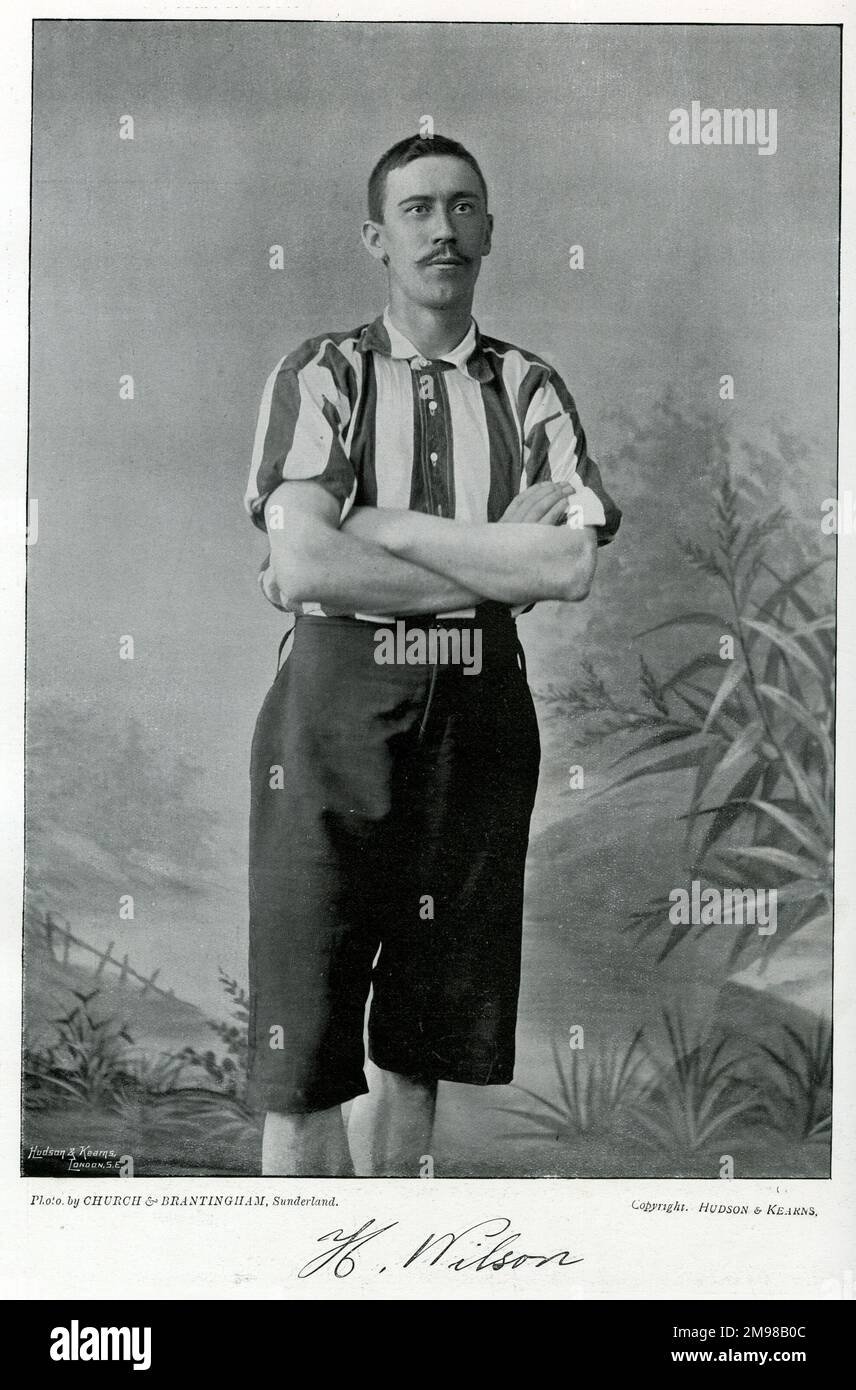
On This Day (18th March 1869): Hugh ‘Lalty’ Wilson, Captain Of Sunderland’s ‘Team Of All Talents’, Is Born

Hailing from Mauchline in East Ayrshire, Lalty’s family home is deep in Rabbie Burns country. He first played organised football for his hometown team of Mauchline in 1887/88 and the following season played for the Ayrshire Rifle Volunteers. Season 1889/90 saw the volunteers change their name to Newmilns, amalgamating with Newmilns Rangers and Newmilns Star in the process, and Wilson played the 1889/90 season at centre-forward for the Ayrshire outfit. On 22 March 1890, he earned his first cap for Scotland in a five-goal-to-nil victory against Wales; he scored one of the goals in what was described as a very good debut.
His performances brought him to the attention of Sunderland and their manager, Tom Watson, who were about to embark on their first ever season in the Football League.
Scotland was a great source of players for Sunderland at this time, and apart from Wilson, they also signed legendary goalkeeper Ted Doig and potent forward Jaimie Millar.
A substantial signing-on fee of £70 was paid for Wilson’s services.
Lalty made his debut on 13 September 1890 in front of 5,000 fans at the Newcastle Road ground. The opposition were established league members Burnley and although the game ended in a 3–2 defeat for Sunderland, Wilson made a promising debut, but not at centre-forward. For all of this season he mostly played right-half alongside Captain John R Auld another Ayrshire lad who played centre-half and John W Murray another Scot who had also joined the club in 1890 and played left-half.

In Sunderland’s inaugural season in the league, Wilson missed only one game, playing twenty-six league and cup games and helping the Lads to a very respectable seventh position.
With Johnny Campbell and Jamie Millar rattling the goals in, Sunderland won their very first league title in their second season in the league (1891/92). Tom Watson had assembled a very good squad of players. Generally the team would present Ted Doig in goal, full-backs Tom Porteous and Donald Gow. The half-back line Hughie Wilson, John Auld and John Murray. On the wings John Scott and James Hannah. Inside-forwards were Jaimie Millar and David Hannah, with the prodigious Johnny Campbell at centre-forward.
That first title was won by five points from Preston North End who finished runners-up for a second season. On 19 September in this season, Hugh Wilson scored Sunderland’s first ever penalty in a league game.
It was around this time that this Sunderland team became known as the “Team of All Talents”. The accolade appears to have originated from a comment by one of the Football League founders and Aston Villa executive William McGregor who responded to watching his team receive a 7–2 beating from Sunderland on 5 April 1890 by saying “Sunderland had a talented man in every position”.
Lalty was the Scottish nickname given to Hugh. The word is a derivative of laldy (as in “give it some laldy”). The meaning of the word is to do something with immense effort, energy and vigour, giving one’s all energetically and vigorously. This seems to sum Hugh Wilson up to a tee. He is described in the local press with superlatives such as “indispensable” and “priceless”. Wilson scored eight goals in that title-winning season from his half-back position.
Sunderland retained their title in the 1892/93 season, this time with an eleven-point gap to nearest rivals (and third season-in-a-row runners-up Preston North End). Hugh Wilson missed only one game of that season and scored eight goals again to help the Lads to their second title in successive seasons. Hugh displayed his versatility playing a few games at left-half when the need arose for the team.
Sunderland finished runners-up to Aston Villa in the 1893/94 season, with Lalty playing thirty games and scoring four goals in cup and league competitions. With another Scot William Dunlop brought in to replace John Murray, Wilson played most of this season at left-half.
Season 1894/95 saw John Auld pass the captaincy on to Hugh Wilson. He would go on to captain Sunderland from 1894/95 to the end of the 1898/99 season.
In Hughie’s first season as captain he led them not only to be league champions but also ‘world champions’ as they defeated Scottish league champions Hearts by five goals to three in a challenge match at Hearts’ Tynecastle Road stadium.
Captain Lalty played all but four games of that season and scored five goals.

Throughout his time at Sunderland, Hugh Wilson had possessed a huge throw-in when given a chance. The distance at which he could hurl the ball prompted the Football League to outlaw one-armed throws in 1895, making it compulsory to hold the ball with two hands.
The finish of the 1895/96 season would see Sunderland finish fifth and Tom Watson step down from his role as manager and go and take up a similar role at Liverpool.
It would also see Hugh become the first Sunderland player to be sent off in a league game (Stoke on 14 March 1896).
For the 1896/97 season, Johnny Campbell’s brother Robert took over from Tom Watson as manager. With older players moving on or retiring there was a need to bring in some new players. Mathew Ferguson, Peter Boyle, Sandy McAllister and Hugh Morgan all arrived from Scotland. Wilson and Dunlop were joined in the half-back line by Mathew Ferguson.
Sunderland would finish second bottom as a team definitely redefining itself. When Hughie had joined Sunderland, the rules for international selection were that if you plied your trade abroad you could not be selected for your country. In 1896 the rules were changed and he was able to go on and add another three caps to the one he had picked up in 1890.
In the following season Sunderland would finish the season as runners-up to Sheffield United. Hughie would score eight goals and play half the season at left-half and the other half at inside-left. Sunderland had gone mighty close to the title again.
Season 1898/99 would see the team move from Newcastle Road to Roker Park. Wilson played in our first ever league game at Newcastle Road and Roker Park. He also spent the season playing in a number of positions to help the team out, appearing in twenty-seven games and scoring six goals. Sunderland finished seventh in the league, nine points behind champions Aston Villa. Despite the set-back, Hugh Wilson’s performances maintained a high level of consistency and energy, with his long-striding clever play bringing many plaudits.
This season would prove to be Hughie Wilson’s last for Sunderland.
Lalty played 227 games for Sunderland, scoring 45 goals between 1890 and 1899.
A mainstay of the “Team of All Talents” through our most successful period, winning three league titles in 1892, 1893 and 1895 he moved on to Bedminster for the 1899/1900 season and then with Bristol City (courtesy of a merger with Bedminster) in 1900/01.
He moved back to Scotland for the 1901/02 season after signing for Third Lanark, where he helped the team to win the Scottish League title in 1904, the Scottish Cup in 1905 and they were runners-up in 1906. After playing 136 games and scoring 37 goals for the ‘Thirds’, he moved to Kilmarnock for a season (1907/08) where he played 22 games and scored three goals. This was his last season in top-flight football and he retired at the end of this season having played 385 games and scored 85 goals.
Irrespective of his Scottish experience, his nine seasons with Sunderland at the very beginning of their league journey are peppered with highlights, the three league titles are also backed with two runners-up finishes, an astonishing period to be a player and captain, no wonder they were nicknamed “the Team of All Talents”.
