
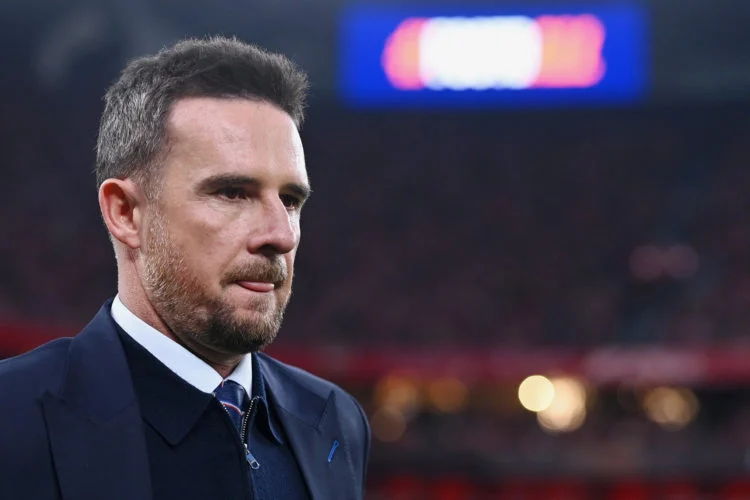
Barry Ferguson’s Furious Response After Mikey Moore Flashpoint in Rangers vs Livingston
Tensions flared dramatically following the heated clash between Rangers F.C. and Livingston F.C., as former club captain Barry Ferguson delivered an impassioned public speech in response to the controversial Mikey Moore incident that overshadowed the fixture.
The match itself had already been charged with intensity, but it was a late challenge involving young talent Mikey Moore that ignited fury among supporters and pundits alike. The incident, which saw Moore caught in a heavy collision near the touchline, left players confronting one another and the stadium brimming with frustration. While officials opted for a measured disciplinary decision, many within the Rangers camp believed stronger action was warranted.
Ferguson, never one to shy away from expressing his feelings when it comes to his former club, addressed the situation shortly after the final whistle. Speaking with visible anger, he criticized what he described as a “lack of protection” for emerging players and questioned the consistency of officiating standards.
“I’ve watched Rangers for decades,” Ferguson began, his voice edged with frustration. “And what I saw today crosses a line. If we’re serious about protecting young footballers, then action has to match the words.”
The former midfielder, who captained Rangers during one of the club’s most competitive eras, emphasized that incidents like the one involving Moore could have lasting consequences. “You cannot allow reckless challenges to pass as part of the game’s physical nature. There’s a difference between strong football and unnecessary aggression,” he added.
Ferguson’s reaction quickly gained traction across Scottish football circles. Supporters echoed his sentiments on social media, many expressing concern over player safety and calling for retrospective review. Others, however, argued that the match reflected the traditional physical edge often seen when Rangers face Livingston, a side known for its combative style.
The controversy also sparked debate about how young prospects are integrated into high-stakes matches. Moore, regarded as one of the brightest attacking talents to feature in the fixture, had shown flashes of creativity before being halted abruptly by the contentious tackle. Ferguson highlighted the importance of nurturing such players rather than exposing them to undue risk.
“Talent like that needs confidence,” he continued. “If young lads feel they’re going to be targeted without consequence, it affects how they play. Rangers should always be a place where skill thrives.”
While neither club issued an immediate formal complaint, the Scottish football community awaits potential review from the governing authorities. Matches between Rangers and Livingston have often carried competitive bite, but this episode has reignited conversations around refereeing standards and player welfare in domestic competition.
Ferguson concluded his remarks with a rallying call aimed at both officials and the wider football establishment. “This isn’t about one team. It’s about the game in Scotland. We have to demand better. Passion is part of football — but so is responsibility.”
As the dust settles on a stormy afternoon, attention will turn to whether further action is taken. What remains clear is that Barry Ferguson’s fiery intervention has ensured the Mikey Moore incident will not fade quietly. His words reflect not only anger but a broader concern that Scottish football must strike a balance between its proud physical tradition and the protection of its emerging stars.
