
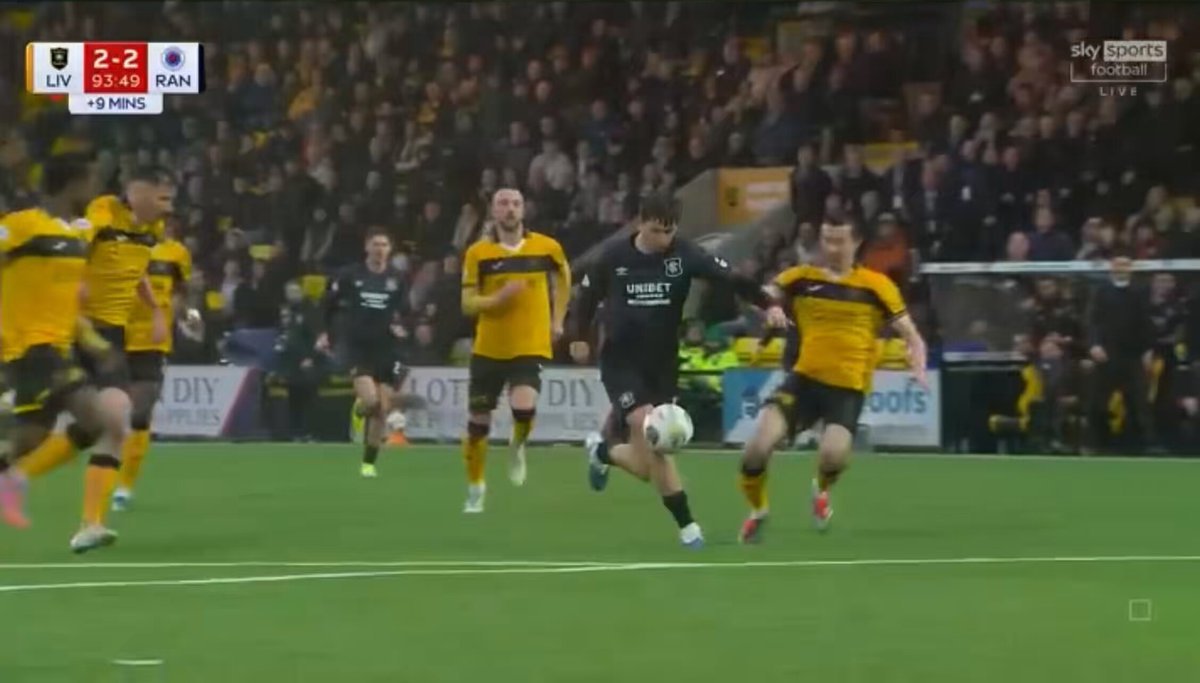
Storm at the Tony Macaroni Arena: VAR Fury as Moore Denied Spot-Kick
A simmering sense of injustice boiled over at the Tony Macaroni Arena on Saturday as a dramatic late challenge on Mikey Moore was waved away following a VAR review, leaving players, staff and supporters incandescent with frustration.
With the match delicately poised in its closing stages, Moore appeared to have seized his moment. Latching onto a threaded pass just inside the box, the young forward showed electric footwork to shift the ball beyond his marker. As he darted goalward, a defender lunged in from the side. Contact followed — enough, it seemed, to send Moore tumbling to the turf.
The referee initially pointed to the spot, sparking wild celebrations among the visiting bench. But the joy was short-lived. A brief pause, a finger to the earpiece, and then the now all-too-familiar rectangle gesture. VAR had intervened.
Inside the booth at Clydesdale House, officials scrutinised the replay from multiple angles. Slow motion showed the defender making what appeared to be a slight touch on the ball before clattering through Moore’s standing leg. After a lengthy check, the referee was summoned to the monitor. The stadium fell into an anxious hush.
Moments later, the verdict arrived: no penalty. Decision overturned. The challenge, according to the officials, was deemed fair.
The reaction was instantaneous and explosive. Moore lay momentarily on the turf in disbelief before rising to remonstrate. Teammates crowded the referee, while the home support roared its approval. On the touchline, coaching staff gestured furiously, replays on tablets doing little to soothe their anger.
Pundits will pore over the footage for days. The crux of the debate hinges on a familiar question in the VAR era: does a minimal touch on the ball absolve subsequent contact? Critics argue that winning the ball does not grant carte blanche to scythe through an opponent. Supporters of the decision insist that the defender’s intervention was strong but legitimate — a robust example of last-ditch defending.
For Moore, one of the brightest emerging talents in the game, the incident felt like a defining moment. At just 17, he has already demonstrated composure beyond his years. In that split second inside the box, he showed the sharpness and bravery that mark elite forwards. Instead of a potential match-winning penalty, he was left with nothing but a sense of grievance.
The controversy also reignites broader questions about VAR’s consistency. Introduced to eliminate clear and obvious errors, it often seems instead to magnify marginal calls. Supporters crave transparency — the audio between referee and VAR, clearer explanations, a better understanding of thresholds. Without them, suspicion festers.
As the final whistle blew, the scoreline remained unchanged, but the debate was only beginning. Social media erupted. Former players weighed in. Frame-by-frame clips circulated within minutes, each side armed with its own interpretation.
Football has always thrived on controversy, but in the age of technology, the arguments feel sharper, more forensic. At Livingston, the technology designed to deliver certainty instead delivered fury.
Whether the decision was technically correct may be dissected endlessly. What cannot be disputed is its impact. In a sport where margins are razor-thin, one overturned call can shift momentum, morale, and perhaps even a season’s trajectory.
And for Mikey Moore, the image of that late challenge — fair or foul — may linger long after the noise subsides.
